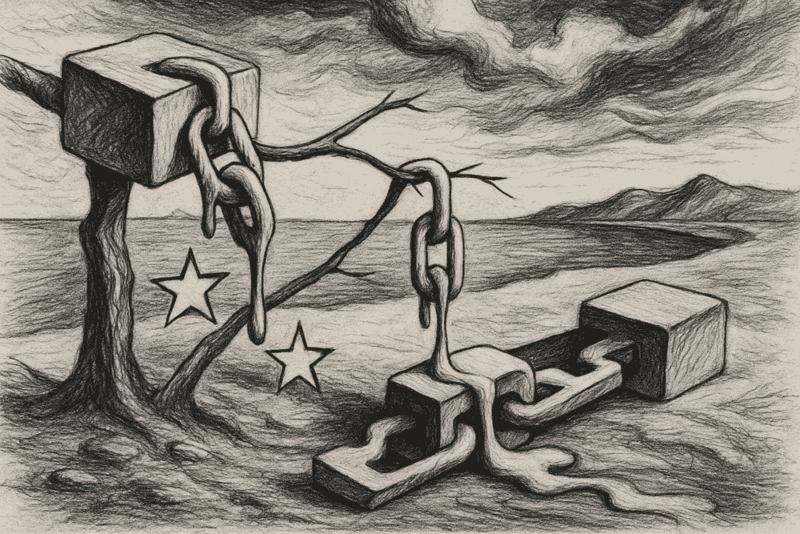
Money, property titles, even aircraft‑maintenance logs are creeping onto blockchains from Stockholm to Wyoming. But what makes this data structure so tamper‑resistant? Grab a pen and a coffee‑shop napkin: we’ll sketch the hash chain with zero math and see why rewriting one block means rewriting the universe.
1 Building a Blockchain on a Napkin
Imagine a stack of receipts where each slip carries its own data and the digital fingerprint of the previous slip.
On the napkin the chain looks like:
#1 Alice→Bob 10 | hash1 = A0F…
#2 Bob→Clara 5 | prev = A0F… | hash2 = 3B4…
#3 Clara→Dan 2 | prev = 3B4… | hash3 = 9C1…
Each new block “signs” the previous one, forming an unbreakable integrity chain.
2 What a Hash Is—and Why It Matters
3 Why Faking One Block Breaks Them All
Suppose Alice wants to erase her payment to Bob.
On public chains Proof‑of‑Work or Proof‑of‑Stake adds cost: while an attacker re‑mines old blocks, honest nodes keep piling on new ones.
4 Real‑World Use Cases in Europe & the U.S.
5 Key Risks & How They’re Mitigated
6 “Napkin Blockchains” Around Us
Hash chains turn a simple list of records into digital reinforced concrete: alter one brick and the entire wall cracks. That’s why banks, governments and logistics giants are testing blockchains—not because the tech is fashionable, but because cheating becomes more expensive than playing by the rules. Once you grasp the napkin sketch, you can judge which “blockchain projects” are real architecture and which are just buzzwords.
1 Building a Blockchain on a Napkin
Imagine a stack of receipts where each slip carries its own data and the digital fingerprint of the previous slip.
- Write: “Alice → Bob, €10.”
- – Mark it #1.
- – Compute a hash—64 random‑looking hex characters.
- Next slip: “Bob → Clara, €5” becomes #2 and stores
- – its own text
- – hash of block #1.
- Block #3 includes the hash of #2, and so on.
On the napkin the chain looks like:
#1 Alice→Bob 10 | hash1 = A0F…
#2 Bob→Clara 5 | prev = A0F… | hash2 = 3B4…
#3 Clara→Dan 2 | prev = 3B4… | hash3 = 9C1…
Each new block “signs” the previous one, forming an unbreakable integrity chain.
2 What a Hash Is—and Why It Matters
- A hash function (SHA‑256, Blake2, Keccak) is a one‑way blender: any text in, a fixed‑length string out.
- Change one comma and the result changes unpredictably—avalanche effect.
- The process is one‑way: from “A0F…” you cannot recover the message.
- Collisions (two messages → same hash) are astronomically rare; brute‑forcing one would outlive the Sun.
3 Why Faking One Block Breaks Them All
Suppose Alice wants to erase her payment to Bob.
- She alters block #1.
- hash1 changes → no longer matches prev in block #2.
- She recalculates block #2 → breaks block #3… endless cascade.
On public chains Proof‑of‑Work or Proof‑of‑Stake adds cost: while an attacker re‑mines old blocks, honest nodes keep piling on new ones.
4 Real‑World Use Cases in Europe & the U.S.
- Sweden: Land Registry tests blockchain deeds; any forged line corrupts the whole audit trail.
- Estonia: Healthcare hashes stored in the government‑run KSI chain; auditors can verify integrity in seconds.
- Wyoming, USA: State law recognises DAOs and uses a chain‑based corporate registry to boost investor trust.
- HSBC + Port of Rotterdam: export documents hashed on a shared ledger, killing the paper “original.”
5 Key Risks & How They’re Mitigated
- 51 % attack — Bitcoin, Ethereum: hash power / stake is widely distributed, making a monopoly ruinously expensive.
- Quantum‑computing threat — NIST, EU Cybersecurity Act: migration paths to post‑quantum hashes like SHA‑3 and Falcon.
- Human error & lost keys — Coinbase, Ledger: hardware wallets, multi‑signature schemes, and rigorous KYC guard against single‑point failure.
6 “Napkin Blockchains” Around Us
- The UK’s NHS pilots hashed e‑prescriptions.
- Air France–KLM writes aircraft inspection logs to a private chain.
- The U.S. FDA backs a pilot under the Drug Supply Chain Security Act to track medicines via hash chains.
Hash chains turn a simple list of records into digital reinforced concrete: alter one brick and the entire wall cracks. That’s why banks, governments and logistics giants are testing blockchains—not because the tech is fashionable, but because cheating becomes more expensive than playing by the rules. Once you grasp the napkin sketch, you can judge which “blockchain projects” are real architecture and which are just buzzwords.